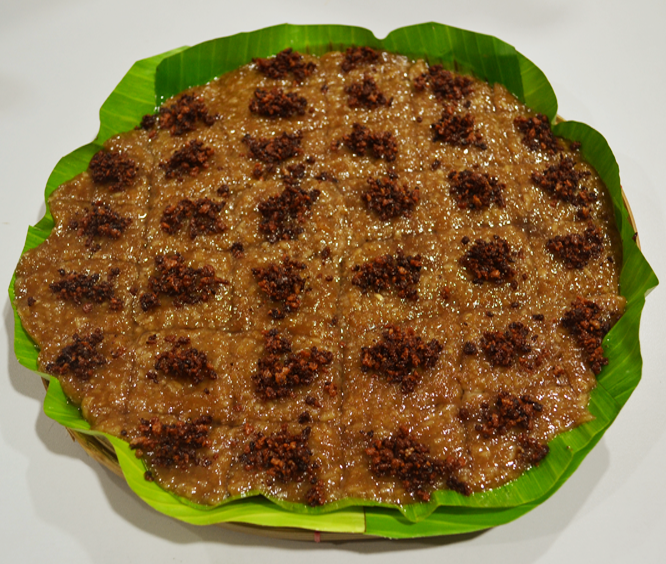
246 kcal per 100 g
Carbs91%•54.7 g
Fat2%•1.6 g
Protein5%•3.3 g
Nutrition highlights
Good source of
Iron2.4 mg20%
Uses FAO/WHO Codex guidelines for nutrition and health claims per 100g.
Monitor
No PNPM warning thresholds are exceeded per 100g.
Uses Philippine Nutrient Profile Model (PNPM) warning thresholds per 100g.
All nutrients
Get enough
Limit
Monitor
The daily targets are estimates for a 19-29 year-old male. Individual needs may vary. For your personal needs, please consult a dietitian.
Calories | 246kcal (9% DV) |
Macronutrients
Total Fat | 1.6 g(3% DV) |
Saturated Fat | 1.41 g(7% DV) |
Cholesterol | 0 mg(0% DV) |
Unsaturated Fat | 0.09 g |
MUFA | 0.07 g |
PUFA | 0.02 g |
Total Carbohydrates | 54.7 g(15% DV) |
Dietary Fiber | 2.1 g(10% DV) |
Sugar | 21.6 g(34% DV) |
Protein | 3.3 g(4% DV) |
Vitamins
Vitamin A | 0 mcg RAE(0% DV) |
Beta-carotene | 0 µg |
Vitamin C | 0 mg(0% DV) |
Vitamin B1 | 0.02 mg(1% DV) |
Vitamin B2 | 0.02 mg(1% DV) |
Vitamin B3 | 0.6 mg NE(3% DV) |
Minerals
Calcium | 14 mg(1% DV) |
Iron | 2.4 mg(20% DV) |
Phosphorus | 53 mg(7% DV) |
Sodium | 92 mg(6% DV) |
Source & Notes
Source: Philippine Food Composition Tables: A169
Values are for general nutrition education. Actual values may vary by ingredients, preparation, and serving size.
Images